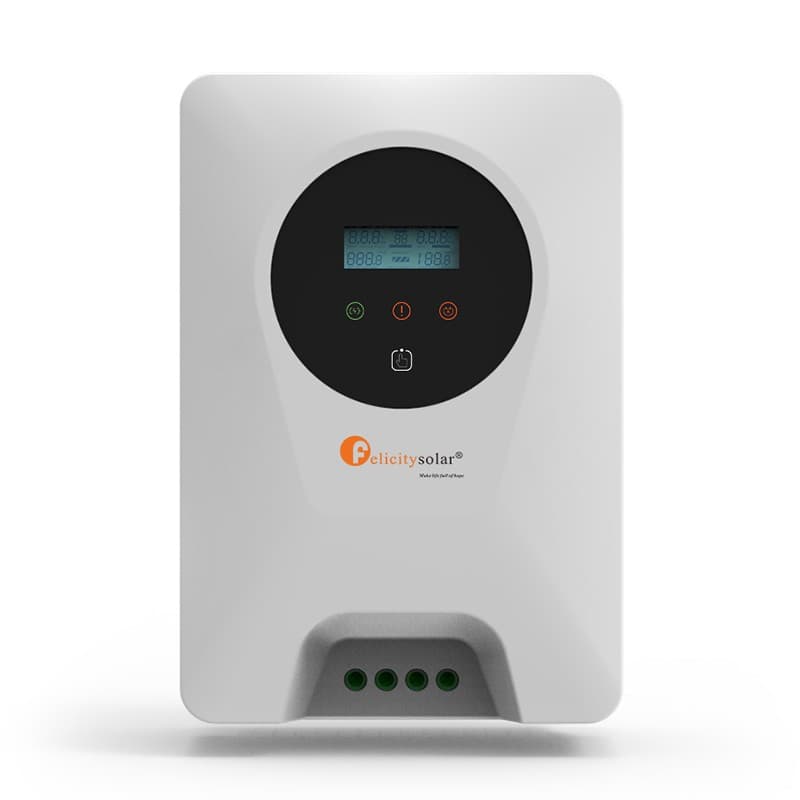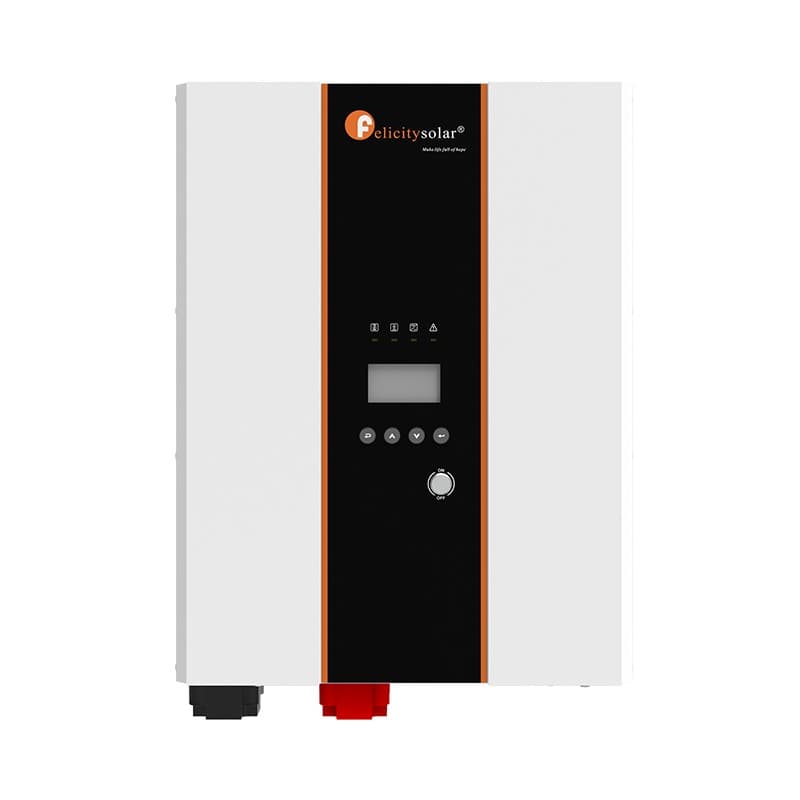
A pump is a surge problem, not a wattage problem. The surge rating row - 2 times rated for 5 or 10 seconds - is what carries the first second of a motor start, and here is what it says on every Felicity inverter and charge controller.
The pump used to run fine. Now there is a new solar system on the land, and the moment somebody presses start, the inverter beeps and cuts out. Nothing is broken and nobody was cheated. The pump was sized on the wrong number.
Here is the whole thing in one paragraph. A pump does not ask for its running power at the moment it starts - it asks for several times that, for a second or two, while the motor gets the water moving. If the inverter was chosen to match the number on the pump's plate, it has no room left for that first second. The row that gives it room is called surge rating, and across our Felicity range it reads 2×rated for 5 seconds on the IVPS, IVPM, IVEM, IVBM and IVCM families, 2×rated for 10 seconds on the IVAM and IVGM ranges, and 1.5×rated for 10 seconds on the large three-phase machines. Twenty-seven listings also carry a plain motor start capable: yes row. A pump is a surge problem, not a wattage problem, and that is the whole of it.
We are an authorised Felicity Solar distributor and we supply Egypt, including Aswan, Cairo, Alexandria and Giza. Send us a photo of the plate on your pump and we will tell you which machine has the headroom to start it: WhatsApp +971 4 255 0887, +971 4 255 0887, or sales@felicitysolar.me.
Why the pump starts on one system and not on another
Think about what the motor is being asked to do. Standing still, it has to overcome a full column of water and its own inertia, all at once. Turning steadily, it only has to keep that column moving. Those are two very different jobs, and the plate on the side of the pump describes the second one.
An old diesel set had a heavy flywheel and an engine that simply grunted through the first second. An inverter has no flywheel. It has a published limit and a stopwatch: it will supply above its rating, by a stated multiple, for a stated number of seconds, and then it protects itself. Ask for more than the multiple, or hold it longer than the seconds, and it disconnects. That is not a fault. It is the machine doing exactly what its sheet says.
So the question at the counter is never "how many kilowatts is my pump". It is "what will this inverter carry for the first two seconds, and does that cover my pump plus everything else that happens to be running at the same time".
The surge row, model by model
| Surge rating | Models |
|---|---|
| 2×rated for 5 s | IVPS1512, IVPS2512, IVPS2524, IVPS3524, IVPS5024, IVPS5048, IVPS7548, IVPS10048, IVPM5048, IVPM7548, IVPM10048, IVEM3024, IVEM4024-II, IVEM5048, IVEM6048-II, IVEM8048-II, IVEM12048-11, IVBM8048P1G1, IVBM10048P1G1 |
| 2×rated for 10 s | IVAM6048P1G1, IVAM8048P1G1, IVAM10048P1G1, IVAM12048P1G1, IVGM5KLP1G1 to IVGM20KLP3G1, T-REX-3KLP1G01 to T-REX-10KLP3G01 |
| 1.5×rated for 10 s | IVGM25KHP3G2 to IVGM50KHP3G2, IVGM75KHP3G1 to IVGM125KHP3G1, T-REX-25KHP3G01 to T-REX-50KHP3G01 |
Now put the ratings beside it, because "2×rated" only means something once you know what it is doubling. The IVPS3524 states 2.8 kW rated output power and 3.5 kVA apparent. The IVPS5048 states 4 kW and 5 kVA. The IVPS7548 and IVPM7548 state 6 kW and 7.5 kVA. The IVPS10048 states 8 kW and 10 kVA. Each of them will carry double that for five seconds, and each of them publishes motor start capable: yes.
Notice which way the multiplier goes on the big machines. The 25 kW and larger three-phase hybrids drop to 1.5×, not 2×. On a large farm that matters: a bigger machine is not automatically a better starter, and a 10 kW off-grid inverter at double rating has more short-term headroom than its raw kilowatts suggest.
What the inverter does when you ask for too much
The useful part is that these machines publish a ladder rather than a single trip point, so you can see how the system will behave on a bad day rather than a good one.
The IVPS5048 and the rest of the IVPS and IVPM range state an overload trip time of 10 seconds above 105% load and 5 seconds above 150%. The IVEM range publishes four steps: 10.5 s above 105%, 7.5 s above 120%, 5.5 s above 150% and 0.2 s above 200%. Read the last two together and the design makes sense. A brief 200% draw while a motor spins up is inside the surge window; a sustained 200% draw is a fault, and the machine lets go in two tenths of a second instead of damaging itself.
This is also why a pump that "sometimes" starts is not a mystery. On a cool morning with nothing else running, the surge fits. On a hot afternoon with the house load already on the same inverter, the same start pushes past the ladder.
Pumping straight off the panels: the charge controller side
Not every irrigation setup runs through a battery. Where the pump works during daylight, a charge controller and a DC bus can do most of the work, and the controller's own rows decide what array you can build.
| Controller | Charge current | Max PV input voltage | Max input power |
|---|---|---|---|
| SCCM30-120-III | 30, 45, 60, 80, 100 or 120 A | 95 V (30-45 A), 145 V (45-80 A), 165 V (100-120 A) | at 48 V: 2,500 W to 6,600 W depending on model |
| SCCM8048-II | 80 A | 145 V | 4,400 W at 48 V |
| SCCM15048 | 150 A | 500 V | 9,000 W |
Three rows on that table are worth reading twice. The maximum PV input voltage is a hard ceiling on how many panels go in a string - exceed it and you damage the controller, and cold mornings raise open-circuit voltage rather than lower it. The maximum input power is what the controller will actually convert. And the MPPT window tells you where it works properly: the SCCM15048 tracks from 150 to 450 V DC and needs 120 V to start up at all, while the SCCM8048-II tracks 60 to 130 V DC on a 48 V battery. All three state a maximum efficiency of 98% and a three-stage bulk, absorption and float charge algorithm. The SCCM8048-II adds transient surge protection of 4,500 W per port; the SCCM15048 states 2× rated power for five seconds.
If your array is a low-voltage one, the IVPM7548 is built for exactly that: an MPPT range of 65 to 145 V, a maximum PV input voltage of 170 V, 6.6 kW of PV, 120 A of solar charging and 60 A of charging from the mains or a generator, in a 6 kW machine that carries double rating for five seconds.
The mistake that costs a controller in Upper Egypt
Every SCCM controller in the range publishes installation: indoor wall-mount and an enclosure rating of IP20 (indoor and vented). Five of them - SCCM2024-II, SCCM3024-II, SCCM4524-II, SCCM8048-II and SCCM12048-II - additionally publish an IP rating of IP31. The first digit of IP31 is a 3, which is about solid objects, not dust. None of these belongs on a post in the open next to the pump.
The one exception in the range is the SCCM15048, which publishes IP54 - dust-protected and splash-protected. Even so, shade and airflow matter: the ambient temperature range on the controllers is 0 to 55 °C, and on the IVPS and IVPM inverters it is 0 to 40 °C, with the IVEM8048-II at -10 to 50 °C. Put the electronics in the coolest ventilated shelter on the plot, run cable to the pump, and let the panels take the sun. There is a full breakdown of what each rating permits in the guide to indoor and outdoor ratings.
Irrigating after dark
If water has to move at night, the array is no longer the source and a battery is. The FLA48200 is 10 kWh at 51.2 V with a 200 Ah capacity, a cycle life of 6,000 cycles and a depth of discharge above 95%; the FLA48300 is 15 kWh and 300 Ah on the same terms, with a peak charge and discharge current of 200 A for 15 seconds. Both carry a built-in smart BMS with a breaker and a fuse and report to the inverter over CAN and RS485, and up to 15 units can be paralleled.
That 15-second peak current row is the one to check against a pump. It is the battery's own version of the inverter's surge row, and a start that the inverter can carry still has to be fed by the pack behind it.
How to size it without guessing
Read the plate on the pump and write down its power and its voltage. Note whether it is single-phase or three-phase, because that alone rules half the range in or out. Add anything else on the same inverter that could be running when the pump starts. Then pick a machine whose rated power covers the steady load and whose surge row covers the start with room to spare - and if the pump is the biggest thing on the farm, buy the headroom rather than the exact fit.
For most single-phase irrigation on a smallholding, that lands on the IVPS7548 or the IVPS10048, with the IVPM7548 where the array is low-voltage and the SCCM15048 where a high-voltage string feeds a 48 V bank. Send us the plate photo and we will do the arithmetic against the published rows. The full range is on the inverters page and the charge controllers page.
Frequently Asked Questions
Why does my solar inverter trip when the pump starts?
What size inverter do I need for an irrigation pump?
Can I run the pump straight from the panels without a battery?
Can I mount the charge controller outside next to the pump?
What if I need to irrigate at night?
Who supplies Felicity Solar for farms in Egypt?
Ready for a personalized quote?
WhatsApp us — average reply time under 15 minutes.