The honest answer is that solar first replaces the hours the engine runs, not the engine. Here is what the Felicity records actually publish about pairing with a generator - the input windows, the generator current rows and the charge current that decides how long it runs.
You already pay for a generator, and you would rather not. That is the question behind almost every solar enquiry we get from Beirut, and the honest answer is more useful than the one you were hoping for: for most apartments and small buildings, solar does not delete the engine on day one. It changes what the engine is for, and it can shrink how long it has to run. Whether it eventually replaces it depends on your roof, your evening load and your patience - not on a brochure.
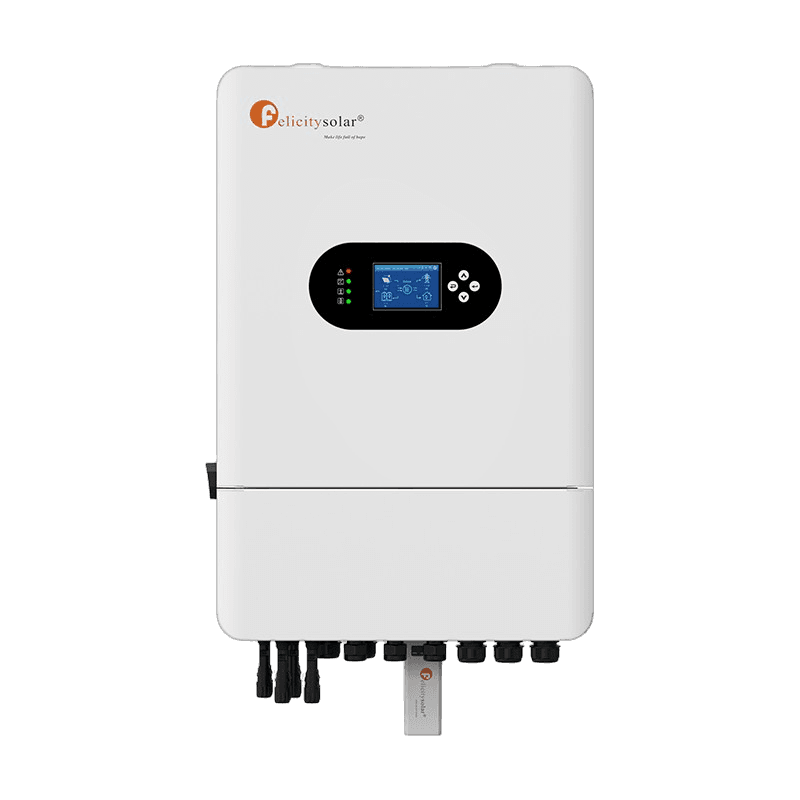
Here is the part that is checkable rather than rhetorical. A Felicity inverter does not treat a generator as a foreign object: twenty-four listings publish an input voltage waveform row that reads Sinusoidal (utility or generator), meaning the machine does not care which of the two is upstream. Three publish a dedicated generator current: the IVAM12048P1G1 states a maximum generator input current of 60 A, and the IVBM8048P1G1 and IVBM10048P1G1 both state 32 A. And the AC charge current row - 50 A on the IVPS5048, 100 A on the IVEM5048, 200 A on the IVBM10048P1G1 - tells you how fast the engine can refill your battery, which is the single figure that decides how long it has to run at all.
We are an authorised Felicity Solar distributor and we supply Lebanon, including Beirut, Tripoli and Sidon. Tell us what your building's supply actually looks like - mains hours, generator, what you need running - and we will match it to the published rows: WhatsApp +971 4 255 0887, +971 4 255 0887, or sales@felicitysolar.me.
What solar actually replaces, and what it does not
An engine converts fuel into electricity whenever you ask it to, day or night, cloudy or clear. Its limit is what is in the tank. A solar and battery system converts daylight into stored electricity and hands it back later. Its limit is the array that collected it and the pack that holds it. Those are different machines solving the same problem from opposite ends, and pretending otherwise is how people end up disappointed.
So: solar replaces the hours the engine would otherwise have run to cover a load that daylight and a battery can cover instead. It does not replace a week of heavy cloud with an undersized array. It does not replace a load larger than the inverter's rating. And it does not replace the engine's role as the thing that will still start at three in the morning in February when the pack is empty. What it does, reliably, is take the routine evening load off the engine - and on many buildings that is most of the running.
The realistic first step in a Beirut apartment is therefore not deleting anything. It is putting a battery and an inverter between you and whatever supply exists, so that the supply becomes something that charges a pack rather than something your lights depend on minute by minute.
Will the inverter accept the building's generator?
This is a published row, not a sales claim. Twenty-four listings state the input voltage waveform as Sinusoidal (utility or generator), including every IVPS and IVPM model, the IVEM5048 and its SALV and LV variants, both IVCM models and both IVBM models. The machine accepts either source on the same input.
Three records go further and name the engine directly:
| Model | Row | Figure |
|---|---|---|
| IVAM12048P1G1 | Max generator input current | 60 A |
| IVBM10048P1G1 | Max generator input current | 32 A |
| IVBM8048P1G1 | Max generator input current | 32 A |
The two windows that decide whether an older engine will pair
A generator's output voltage moves under load, and a small or heavily loaded set moves more. The inverter has to decide whether to accept that or drop it, and it publishes both windows so you can choose.
The IVPS, IVPM, IVEM, IVBM and IVCM families all state an input voltage range of 90-280 V in appliance mode and 170-280 V in UPS mode. Appliance mode is the tolerant setting and is the one to use behind an engine. The IVPS5048 publishes the exact thresholds: it lets go of the supply at 90 V in appliance mode and takes it back at 100 V, against 170 V and 180 V in UPS mode, with a high-line disconnect at 280 V and reconnect at 270 V.
Frequency matters just as much and is the window people forget. The same record disconnects below 40 Hz and above 65 Hz, reconnecting at 42 Hz and 63 Hz. An engine that droops badly when a big load steps on will be dropped by the inverter - which is correct behaviour protecting your equipment, but it is worth knowing before you blame the inverter.
By contrast the IVGM and T-REX hybrids publish 184-264.5 V. That is a grid-tied window, and it expects a supply close to nominal. It is not the natural choice behind an older generator.
How long does the engine have to run? Read the charge current
This is where the mechanism becomes practical. If the engine's job is to refill a battery rather than to power the building directly, then how long it runs is set by how fast your inverter can charge.
| Model | AC charge current from utility or generator |
|---|---|
| IVPS5048 | 50 A |
| IVPS7548 and IVPM7548 | 60 A |
| IVPS10048 | 80 A |
| IVEM5048 | 100 A |
| IVEM6048-II | 120 A |
| IVEM8048-II and IVBM8048P1G1 | 150 A |
| IVBM10048P1G1 | 200 A |
| IVEM12048-11 | 240 A |
Do the arithmetic in amp-hours and it is immediately obvious. An FLA48200 is a 200 Ah pack. A charger running at 50 A puts back roughly 200 Ah in four hours of engine time before conversion losses; a charger running at 200 A does the same work in about one. That is the honest form of the running-cost argument - a statement about hours and amps, which we can evidence from our own records, rather than a statement about money, which we cannot.
What happens in the gap when the supply drops
In a flat with sensitive equipment, the changeover is what you notice. Both IVBM models state 10 ms in UPS mode and 20 ms in appliance mode. The IVCM3224P1G2 states 4 ms in UPS mode. The IVPS and IVPM families state 15 ms. The IVEM family publishes 50 ms as its general figure, with the IVEM5048 additionally stating 20 ms in appliance mode and 10 ms in UPS mode on the same record.
One more row that matters on the day a battery goes for service: pass-through without battery. The IVEM family, both IVBM models, the IVCM pair, the IVGM10KLP3G1 and the T-REX-10KLP3G01 state yes. Every IVPS and IVPM listing states no. If the flat has to stay powered from the generator while the pack is out, that single row decides which machine you buy.
The battery is what turns an engine's hour into a whole evening
Without storage, a generator has to run whenever you want power. With storage, it runs to fill a pack and then stops. That is the entire mechanism, and the pack is what makes it possible.
For an apartment, the FLB48100WG1 is 5.12 kWh at 51.2 V, wall or floor mounted, with a protection degree of IP65 and up to 32 units in parallel for a maximum system of 163.84 kWh. The FLB48205WG1 is 10.5 kWh and the FLB48230WG1 11.8 kWh on the same IP65 wall-pack pattern. For a house or a small building, the FLA48200 is 10 kWh and the FLA48300 15 kWh, both at 51.2 V with a cycle life of 6,000 cycles and a depth of discharge above 95%, and both carrying a built-in smart BMS with a breaker and a fuse reporting over CAN and RS485.
What to ask a supplier before you sign
Be wary of any quotation that arrives with a monthly number already attached to it. What a solar system does to what you pay turns on the price of fuel, on how your building shares its supply and on your own consumption pattern, and a supplier who has measured none of those three is estimating - which is a polite word for guessing. Ask instead for the things that can be checked on the day: the exact model, its surge and input rows, its charge current, who commissions it, and what warranty term comes with it.
What a specification sheet can promise is narrower and far more useful. The inverter will accept an engine on the same input as the mains. It publishes the exact voltage and frequency limits at which it will refuse a bad one. And it publishes how fast it turns engine hours into stored energy. Those three facts are enough to design a system honestly, and all three sit on the product page where anyone can read them back to you.
Where to start in a Beirut building
If your supply is unstable and you want the widest tolerance with a fast changeover, the IVBM10048P1G1 gives you the 90-280 V appliance window, 10 ms in UPS mode, 200 A of charging, a 32 A generator input row and IP65. For a smaller flat, the IVEM5048 is a 5 kW machine with 100 A of AC charging, 100 A of solar charging and pass-through without a battery. For a house with a bigger load, the IVPS7548 and IVPS10048 pair a 90-280 V window with 60 A and 80 A of charging. Then size the pack to your evening, not to the engine. The full range is on the inverters page and the batteries page.
Frequently Asked Questions
Can a Felicity inverter run with a generator?
Will solar let me switch the generator off completely?
How fast can a generator recharge my battery?
Will my older generator actually work with the inverter?
Will the flat stay powered if I take the battery out for service?
Who supplies Felicity Solar in Lebanon?
Ready for a personalized quote?
WhatsApp us — average reply time under 15 minutes.