Most pumps that refuse to turn are sitting on an inverter that looked big enough on paper. Here is the one line on the listing that decides it, why the kilowatt figure on the box misleads, and how to turn your pump's own nameplate into a model you can order.
The fastest way to buy the wrong inverter for a pump is to match its kilowatts to the pump's. Do that and the motor will not turn at all — the protection trips before it breaks away from standstill, every time you ask it to start. On an irrigated holding around Al Ahsa the load is almost never a house. It is a motor: a borehole or surface pump that has to start, run a cycle through the heat, stop, and do it again tomorrow. That single fact changes which number on an inverter's page you should be reading, because the figure printed largest on the box — the rated output in kilowatts — is not the figure that decides whether your pump actually starts. We are the authorised Felicity Solar distributor supplying Saudi Arabia from our own stock, and this is the sizing conversation we have most often with buyers in the Eastern Province.
This guide is only about the pump and the inverter that has to swallow it. The market picture for the region is in the Saudi off-grid overview, and wiring the pump into a complete holding — array, bank, controller, second source — is the subject of the farm system guide.
Products mentioned in this article
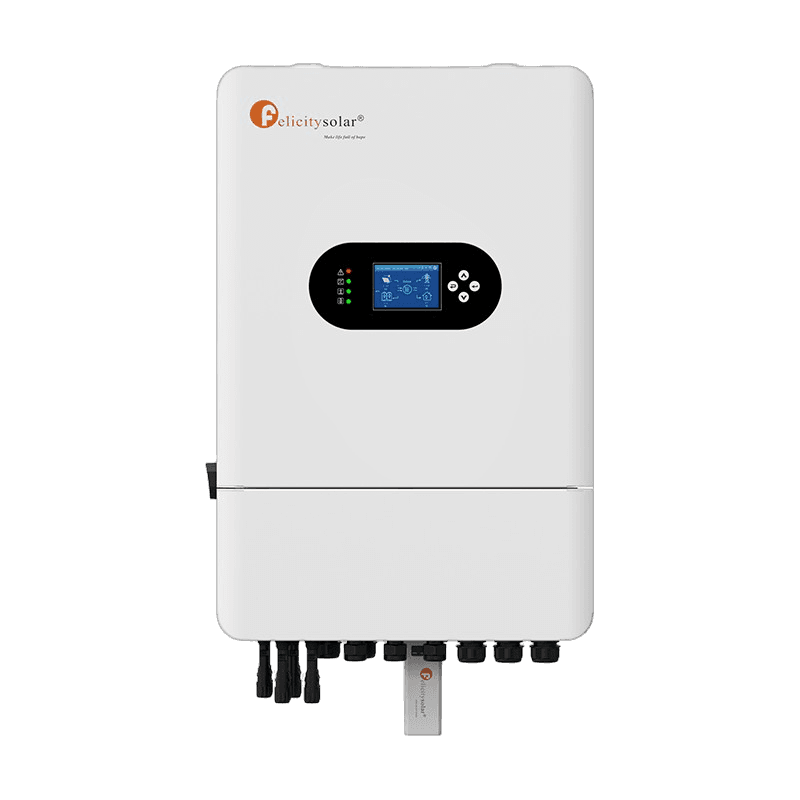
Felicity Solar IVBM8048P1G1 8kW Single-Phase Off-Grid Solar Inverter
- Rated Output Power:8 kW
- Max Efficiency:94.5 %
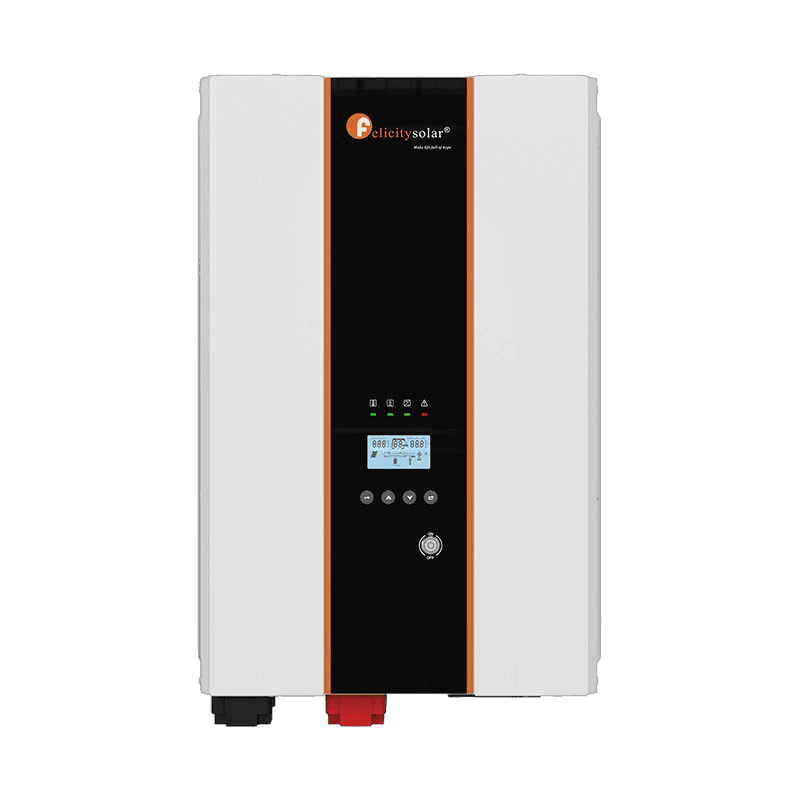
Felicity Solar IVPM10048 8kW Single-Phase Off-Grid Solar Inverter
- Rated Output Power:8 kW
- Max Efficiency:90 %
Felicity Solar IVPM7548 6kW Single-Phase Off-Grid Solar Inverter
- Rated Output Power:6 kW
- Max Efficiency:90 %

Felicity Solar IVAM8048P1G1 8kW Single-Phase Off-Grid Solar Inverter
- Rated Output Power:8 kW
- Max Efficiency:97.6 %

Felicity Solar FLA48300 51.2V 15kWh LiFePO4 Battery
- Nominal Energy:15 kWh
- Nominal Capacity:300 Ah

Felicity Solar FLA48400TG1 51.2V 20.48kWh LiFePO4 Battery
- Nominal Energy:20.48 kWh
- Nominal Capacity:400 Ah
Why matching the kilowatts is how a pump ends up not starting
An induction motor draws far more current in the instant it breaks away from standstill than it draws once it is turning. Nothing about that is controversial; it is simply how motors behave. The consequence for an off-grid system is blunt: an inverter chosen to match the pump's running power will meet the starting draw with a protection trip rather than with current, and the pump will never turn at all. The system is not undersized by ten per cent. It is undersized for an event that happens every single time the pump is asked to start.
So the sizing question is not "how many kilowatts is my pump". It is "what does this inverter promise to deliver above its rating, and for how long". Felicity prints exactly that as a row.
The one line that decides whether it starts
On every Felicity inverter page the row is called Surge Rating, and it is written as a multiple and a duration together. The values are not uniform across the catalogue, which is the whole reason to read it rather than assume it.
- The IVPS and IVPM families print 2*rated (5s). That is twice the rated power, held for five seconds.
- The IVEM and IVBM families print the same 2*rated (5s).
- The IVAM family prints 2*rated (10s) — the same multiple over twice the window.
- The large three-phase IVGM units print 1.5*rated (10s) — a smaller multiple over the longer window.
Both halves of that row are load-bearing. A multiple with no duration is meaningless, because a motor's inrush is an event with a length, and a supply that can hold double power for five seconds is making a different promise from one that holds it for ten. When you compare two models, compare the pair, not the number in front of it.
Worked from the row rather than from a rule of thumb: an IVPM7548 prints a rated output power of 6 kW, so its surge row promises 12 kW for five seconds. An IVPM10048 prints 8 kW, so the same row promises 16 kW. An IVAM8048P1G1 also prints 8 kW, but its row promises 16 kW for ten seconds. Those are three genuinely different machines for a motor, and the difference is invisible if you only read the kilowatt figure.
Two power figures, not one — and your motor feels both
Every Felicity inverter page prints Rated Output Power in kW and Rated Apparent Output Power in kVA as separate rows, and on some models they are not the same number. The IVPS10048 and IVPM10048 print 8 kW alongside 10 kVA. The IVPM7548 prints 6 kW alongside 7.5 kVA. The IVAM8048P1G1 prints 8 kW alongside 8 kVA, and the IVBM8048P1G1 prints 8 kW alongside 8 kVA.
A motor is not a heater. It draws current that is partly doing work and partly doing nothing but magnetising the machine, which is precisely the gap the two rows describe. Read them as a pair: the kW row tells you the work available, the kVA row tells you the current the output stage is built to carry, and for a pump the second one is not decoration.
Where the maker says outright that it starts motors
Several Felicity listings carry a row called Motor Start Capable, printed as Yes. The IVPS10048, IVPS7548, IVPM7548, IVPM10048, IVPM5048, IVEM5048 and IVBM8048P1G1 pages all print it.
Two things follow. First, when a manufacturer states that in a row of its own, it is a claim you can hold it to rather than an inference you made. Second — and this is the part worth being careful about — the IVAM8048P1G1 page does not print that row at all. That is not a "no". It means the figure is not published, and a specification that is not published is not a promise. If motor starting is the whole reason for the purchase, choose from the models that state it, or ask us to confirm before you order rather than inferring it from a family name.
If it starts, then trips a minute later
The surge row covers the first few seconds. The rows that cover everything afterwards are the overload trip times, and the IVPS, IVPM and IVBM pages print two of them: Overload Trip Time (>105% Load) = 10 s and Overload Trip Time (>150% Load) = 5 s.
Read those together with the surge row and the machine's behaviour becomes predictable rather than mysterious. A brief inrush inside the surge window is passed. A sustained draw slightly over rating is tolerated for ten seconds and then dropped. A heavy sustained overload is dropped in five. A pump that is stiff, silted or lifting against a head it was never chosen for will sit in one of those two bands rather than in the surge window — and the inverter will keep tripping while the datasheet numbers all look correct, because the problem is on the hydraulic side and not the electrical one.
What a running pump feels when the power source swaps
Where a site has a second supply — mains, or an engine that runs part of the day — the inverter has to hand the load over between sources without the motor noticing. The transfer time row is what to read. The IVPS and IVPM families print 15 ms. The IVBM8048P1G1 prints two figures for two behaviours: 10 ms in UPS mode and 20 ms in appliance mode. The IVEM family prints 50 ms. Those are not interchangeable when the load on the other side is a spinning motor rather than a light bulb.
The battery has to deliver the surge too
This is the step most pump sizing skips. In an off-grid system, the current that starts the motor does not come from the inverter; it comes through the inverter, out of the battery. So the bank has its own surge row and it has to be read alongside the inverter's.
Felicity's LiFePO4 pages print three separate current rows rather than one, and the distinction is the point:
- The FLA48300 prints a recommended charge/discharge current of 120 A, a maximum continuous charge/discharge current of 150 A, and a peak charge/discharge current of 200 A for 15 seconds.
- The FLA48200 prints the same 120 A recommended figure and a peak of 150 A for 15 seconds.
- The FLA48400TG1 prints a maximum continuous figure of 200-250 A and a peak of 300 A for 15 seconds.
Notice that the battery's peak window is fifteen seconds while the inverter's surge window is five or ten. The bank is therefore not usually the binding constraint on a start — but "not usually" is not "never", and the check costs one look at two pages. What the recommended figure is telling you is different again: it is the current the pack is specified to work at habitually, as distinct from the ceiling it will tolerate, and a pump that starts several times a day lives in the habitual column, not the ceiling one.
If the bank is lead-acid rather than lithium, the equivalent row is the maximum discharge current. The G12V200AH gel block prints an internal resistance of 4 mΩ and a maximum discharge current of 2000 A; low internal resistance is what keeps terminal voltage from collapsing during the inrush, which is the mechanism behind a start that succeeds on one bank and fails on another of the same nominal capacity.
How often it has to start, which is the other half of the problem
A pump is not a one-off event. It runs a cycle, stops, and runs again, and between cycles the bank has to be put back where it started. That makes the charging rows part of pump sizing rather than an afterthought.
The IVPM7548 prints a maximum charging current of 60 A and a maximum solar charging current of 120 A. The IVPM10048 prints 80 A and 120 A. The IVBM8048P1G1 prints 150 A for both its AC charge current and its solar charging current. Those numbers set how quickly the bank can be refilled between runs, and on a site where the pump has to go again in the afternoon they matter as much as the surge figure does.
The battery's own temperature rows belong in the same calculation, because a pump duty cycle in the Eastern Province is a hot-weather duty cycle. The FLA48300 prints a charging temperature range of 0-55 °C and a separate discharging range of -20 to 55 °C, and the FLA48400TG1 additionally prints an optimal operating temperature of 20-30 °C. Two different rows, two different questions, and the optimal band is not the same statement as the permitted range.
One row that catches people out
The IVPS and IVPM families print Pass-Through Without Battery: No. The IVBM8048P1G1 prints Yes.
On a pump site that plan is common: run from the engine while it is on, from the battery when it is off. The row above decides whether that plan survives the day the bank is disconnected for service or is taken out by a fault. On an IVPS or IVPM, no battery means no output, even with a perfectly good AC source connected to the input. On an IVBM8048P1G1, the source passes through. Neither behaviour is wrong; installing the first one while assuming the second is.
Turning your pump's nameplate into a model choice
We do not publish pump flow rates, heads or motor ratings, and we will not estimate yours — those figures belong to the pump on your site and its own nameplate. What we can do is show the route from that plate to a row on a listing.
Start from the motor's rated input power as its own nameplate states it. Compare that with the inverter's Rated Output Power row, which must comfortably exceed it for the running phase. Then take the inverter's Surge Rating row, apply the multiple to the rated power, and check that the result covers the starting draw the pump manufacturer publishes for that motor. If it does not, the answer is a larger unit or a different starting arrangement, never a hope that the trip will not fire. Finally, check the battery's peak current row and the inverter's charging current rows so the bank can both supply the start and recover before the next one. If you would rather have that assembled for you, the sizing tool takes the loads and returns specific model codes from this catalogue.
Frequently Asked Questions
What size inverter does my water pump need?
The listing says 2*rated (5s) — what does that mean for my pump?
Can my battery deliver the kick the pump needs at start-up?
Can I run a pump straight off the panels with no battery at all?
Which Felicity inverter should I buy for an irrigation pump?
Will the pump start when the site is running on a generator?
My pump starts, then trips a minute later. Why?
Do you sell the water pump itself?
Ready to order?
Every unit in the catalogue carries its price — add it to the cart and order online, delivered within 3 business days.