160kW of PV input across 8 MPPT trackers
two strings and 45A per tracker at up to 1000V, tracked from 150V to 850V and 444-850V at full load

Carrying 160kW of array on 8 MPPT trackers, the IVGM80KHP3G1 puts out 80kW continuously, 88kVA at its apparent-power ceiling, and 127.5A of current.
In stock
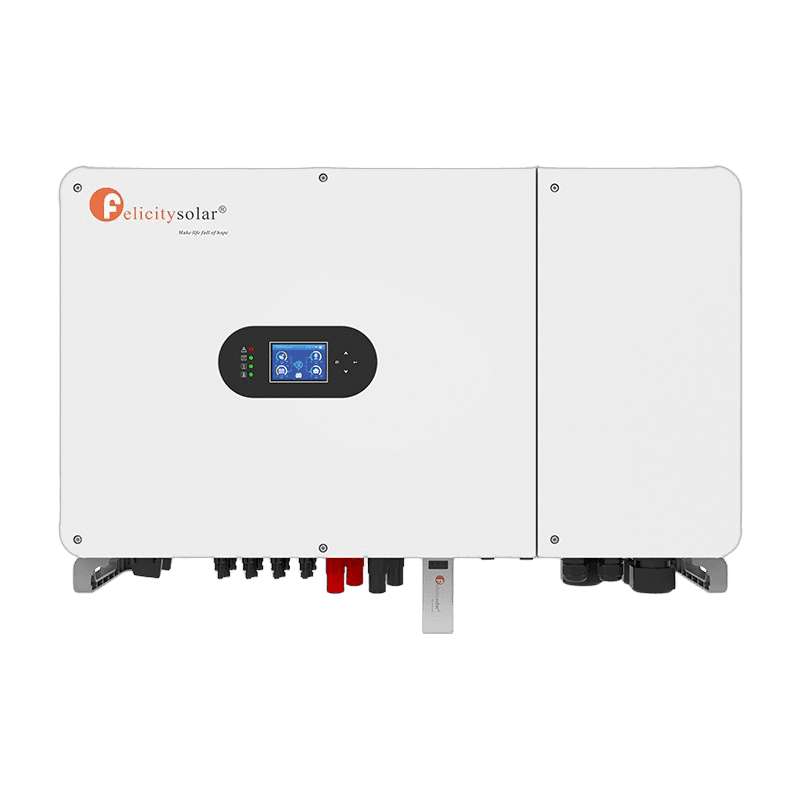
The Felicity Solar IVGM80KHP3G1 accepts 160kW of PV across 8 MPPT trackers and turns it into 80kW of three-phase output, 80kVA rated apparent and 88kVA at maximum, alongside 127.5A of output current, 97.6% peak efficiency, a 160-1000V battery window and a warranty of 2 Years. Every tracker holds two strings at 45A, tolerates 1000V of PV, and works from a 180V start-up across 150-850V, tightening to 444-850V when the unit runs at full load; rated PV input voltage is 600V. The output is 3L+N+PE, at 380-400V of line voltage and 220-230V per phase, rated 116A, protected at 218A, with 270A available through the AC pass-through. Two inputs move 120+120A into and out of LFP packs, the charge algorithm following the BMS on RS485 and CAN; transfer to the 80kW backup output takes 0ms and surge capacity is 1.5 times rated power for 10s. The wall-mounted, Non-Isolated IP66 cabinet is smart-cooled, stands 814.5 mm tall by 1271 mm wide and 379.5 mm deep, and carries 156kg net. We are an authorised Felicity Solar distributor and supply the IVGM80KHP3G1 from our own stock.
Specifications last updated 17 August 2026
| AC Output Line Voltage | 380-400 V |
|---|---|
| AC Output Voltage | 220-230 V |
| AC Rated Output Current | 116 A |
| AC Wiring Mode | 3L+N+PE |
| Backup Rated Output Power | 80 kW |
| Battery Inputs | 2 |
| Battery Type | LFP |
| Battery Voltage Range | 160-1000 V |
| Charge Algorithm | Self-Adaption to BMS |
| Grid Frequency Range (50 Hz) | 45-55 Hz |
| Grid Frequency Range (60 Hz) | 55-65 Hz |
| Grid Regulation | IEC 61727, IEC 62116, CEI 0-21, EN 50549, NRS 097, RD 140, UNE 217002, OVE-Richtlinie R25, G99, VDE-AR-N 4110 |
| Ground Fault Current Monitoring | Yes |
| Input Voltage Range | 184-264.5 V |
| MPPT Full-Load Voltage Range | 444-850 V |
| MPPT Trackers | 8 |
| MPPT Voltage Range | 150-850 V |
| Max AC Input Current | 127.5 A |
| Max AC Pass-Through Current | 270 A |
| Max Apparent Power | 88 kVA |
| Max Charging Current | 120+120 A |
| Max Discharging Current | 120+120 A |
| Max Efficiency | 97.6 % |
| Max Output Current | 127.5 A |
| Max Output Overcurrent Protection | 218 A |
| Max PV Input Current | 45+45+45+45+45+45+45+45 A |
| Max PV Input Power | 160 kW |
| Max PV Voltage | 1000 V |
| Max Short-Circuit Current | 68+68+68+68+68+68+68+68 A |
| Nominal AC Input Line Voltage | 380-400 V |
| Nominal AC Input Voltage | 220-230 V |
| Nominal Input Frequency | 50/60 Hz |
| Output Frequency | 50/60 Hz |
| Output Short-Circuit Protection | Yes |
| Overload Protection | Yes |
| Overvoltage Category (AC) | III |
| Overvoltage Category (DC) | II |
| Phase | Three Phase |
| Power Factor Adjustment Range | 0.8 leading to 0.8 lagging |
| Protection | PV Input Lightning Protection, PV String Input Reverse Polarity Protection, Battery Input Lightning Protection, Battery Input Reverse Polarity Protection, DC Component Detection, Insulation Resistor Detection, Residual Current Monitoring Unit, Arc Fault Monitoring (optional), Output Over Current Protection, Output Shorted Protection, Output Over Voltage Protection, Remaining Current (RCD) Monitoring, Overheat Protection, Anti-islanding Protection, AC Output Lightning Protection |
| Rated Apparent Output Power | 80 kVA |
| Rated Output Power | 80 kW |
| Rated PV Input Voltage | 600 V |
| Start-Up Voltage | 180 V |
| Strings per MPPT | 2 |
| Surge Protection Level (AC) | III |
| Surge Rating | 1.5*rated (10s) |
| Total Harmonic Distortion | <3 % |
| Transfer Time | 0 ms |
| BMS Communication | RS485, CAN |
|---|---|
| Communication Interface | RS232, RS485 |
| Display | LCD, LED |
| Gross Weight | 200 kg |
| Installation Style | Wall-Mounted |
| Monitoring Module | WiFi/Bluetooth/4G/LAN |
| Net Weight | 156 kg |
| Package Dimensions | 1410 x 960 x 646 mm |
| Parallel Capability | 12 |
| Safety Standard | IEC/EN 62109-1, IEC/EN 62109-2 |
| Topology | Non-Isolated |
| Cooling | Smart Cooling |
|---|---|
| IP Rating | IP66 |
| Operating Altitude | 4000 m |
| Operating Temperature Range | -40 to 60 (>45 derating) °C |
| Relative Humidity | 0-100 (non-condensing) % |


Sana'a sits above 2,000 metres, and an inverter whose datasheet permits 2,000 m is not rated for the city at all. Here is the altitude row on 44 Felicity listings, model by model, and which ones cover your elevation.
Read: Which Solar Inverters Actually Work in Sana'a? →Twenty-five Felicity inverters are IP21 and every SCCM charge controller says indoor wall-mount. IP20, IP21 and IP31 are indoor ratings, and the first digit - the dust one - is the half nobody reads. Here is which listing carries which.
Read: Can I Install a Solar Inverter Outside? What IP21, IP31 and IP65 Really Mean →An off-grid house is sized by surge, battery energy and charge current - and the surge row is the one that starts your fridge and your pump. Here are the published figures across the Felicity inverters and batteries, with the arithmetic to use them.
Read: How to Run a Whole House on Solar in Khartoum →160kW of maximum PV input power, divided over 8 MPPT trackers that each carry two strings at 45A and up to 1000V. The full-load tracking window is 444-850V inside a wider 150-850V range, opening at a 180V start-up, at a 600V rated PV input voltage.
127.5A of maximum output current against 116A rated, behind 218A of output overcurrent protection and with 270A of AC pass-through. Output power is 80kW and 80kVA rated, 88kVA at maximum apparent power, under 380-400V of line voltage and 220-230V per phase.
12 units can be paralleled. Monitoring runs over WiFi, Bluetooth, 4G or LAN, with RS232 and RS485 interfaces, an LCD and LED display, and BMS links on RS485 and CAN. The IP66 cabinet works from -40 to 60°C, derating past 45°C, and to 4000m of altitude.
2 Years of warranty. Approvals are IEC 62109-1, EN 62109-1, IEC 62109-2 and EN 62109-2 for safety, plus the grid codes IEC 61727, IEC 62116, CEI 0-21, EN 50549, NRS 097, RD 140, UNE 217002, OVE-Richtlinie R25, G99 and VDE-AR-N 4110.