The engine is already behind the workshop, and this page does not pretend it loses. Where each machine gets its energy, what that asks of you week after week, and the four lines on a listing that decide whether your own generator will work with the inverter. No fuel price, no payback — we do not hold those and will not invent them.
You already own the engine. That is the honest starting point, and it is why this page does not open by assuming it loses. In Saudi Arabia the diesel generator is on the farm already, it is behind the workshop already, and on a compound under construction it is often the only thing keeping the site alive. A comparison that begins by writing it off has skipped the argument. So this one is made on two things we can actually evidence — how each machine gets its energy, and what a Felicity product page prints about pairing with an engine — and on nothing else. You will find no fuel price here, no tariff, no payback period and no emissions figure, because none of those exists in a source this site is permitted to read. We are an authorised Felicity Solar distributor and supply Saudi Arabia from our own stock, and the figures below are rows off our own records.
Products mentioned in this article
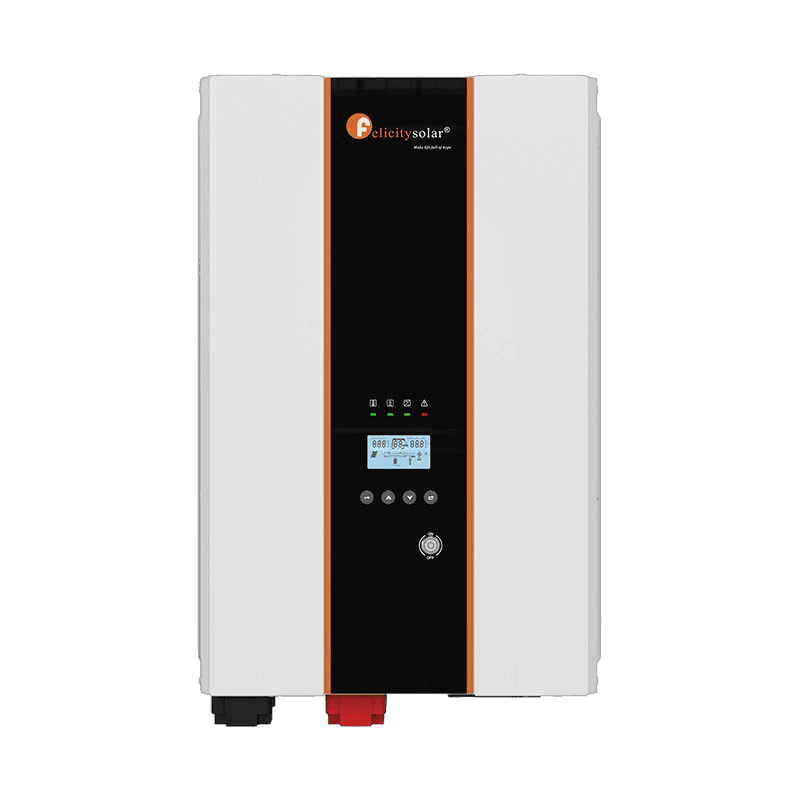
Felicity Solar IVPS5048 4kW Single-Phase Inverter / Charger
- Rated Output Power:4 kW
- Max Efficiency:90 %
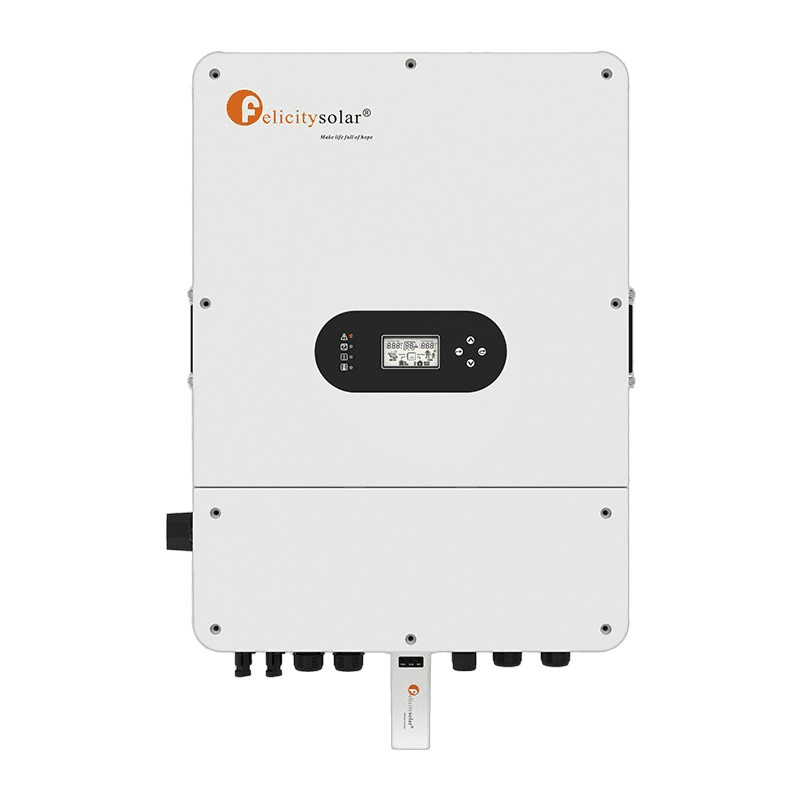
Felicity Solar IVGM5KLP2G1 5kW Single-Phase Hybrid Solar Inverter
- Rated Output Power:5 kW
- Max Efficiency:97.6 %
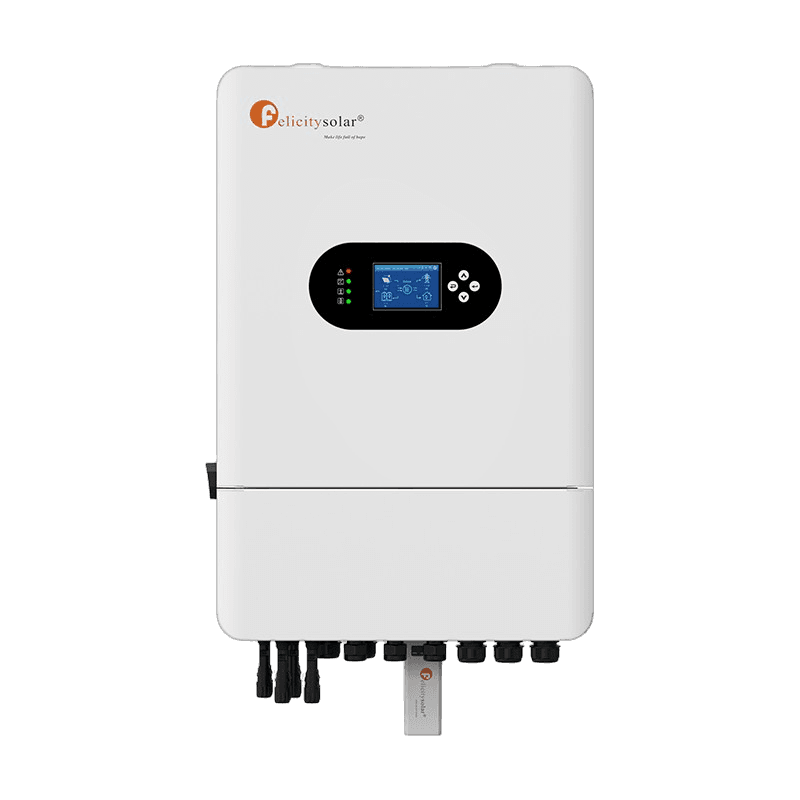
Felicity Solar IVBM10048P1G1 10kW Single-Phase Off-Grid Solar Inverter
- Rated Output Power:10 kW
- Max Efficiency:94.5 %

Felicity Solar IVEM5048 5kW Single-Phase Off-Grid Solar Inverter
- Rated Output Power:5 kW
- Max Efficiency:93 %
Felicity Solar IVPM5048 4kW Single-Phase Off-Grid Solar Inverter
- Rated Output Power:4 kW
- Max Efficiency:90 %
Felicity Solar IVPS1512 1.2kW Single-Phase Inverter / Charger
- Rated Output Power:1.2 kW
- Max Efficiency:90 %
The two machines are solving different problems
An engine converts stored fuel into electricity on demand, bounded by the fuel in the tank and the state of the machine rather than by the weather or the hour — which is why it is the default answer for a load that must run at 03:00 with no notice. A solar and battery system converts sunlight into stored electricity and releases it later, bounded by the array that collected it and the pack that holds it.
That single difference produces every consequence below. The engine's constraint is a supply chain that renews itself every week the machine runs; the battery system's constraint is a forecast, paid once in equipment at the start. Neither is automatically better — they fail in different directions, and the site decides which failure you can live with.
The real argument is who fetches the fuel
Every kilowatt-hour an engine produces arrives by road first. On a Riyadh compound that is a delivery schedule, a tank and somebody whose job it is to notice the level. On a holding outside Al Ahsa it is a tanker that has to physically reach the plot, on whatever track leads to it, for the life of the installation.
A solar and battery system moves that road journey to the front of the project and then stops. The equipment arrives once, and the figures involved are printed: an IVPS5048 weighs 29.1 kg net in a 494 x 420 x 195 mm cabinet, and an FLA48300 weighs 135 kg net and 160 kg packed in a 635 x 498 x 1150 mm carton. Those are the two deliveries. After that, the fuel arrives without a vehicle. This is the honest form of the running-cost argument — a statement about vehicles and schedules, which we can evidence, rather than a statement about riyals, which we cannot.
What each one asks of you, week after week
An engine has moving parts under load and consumables that deplete while it runs. We are not going to quote you a service interval or a rebuild point, because no source we are allowed to read publishes one; your own supplier's schedule is the authority on that, and it is worth putting on the table next to what follows.
What we can quote is the other side. The FLA48100, FLA48200, FLA48280 and FLA48300 all state a cycle life of 6,000 cycles with a depth of discharge printed separately above 95%, and every one of them carries a built-in Smart BMS with a breaker and a fuse, reporting over CAN and RS485 to the inverter with an LCD at the cabinet. The wear is counted in cycles and the state is reported on a bus, which is a different kind of maintenance relationship from an engine's — not necessarily a lighter one, but a measurable one.
On the inverter side the equivalent rows are the cooling method and the overload behaviour. The IVPS5048 states Intelligent Air Cooling, and it publishes exactly when it gives up: the overload trip time is 10 s above 105% load and 5 s above 150%. The IVGM range uses Smart Cooling, while the T-REX-5KLP1G01 and IVGM5KLP1G1 state Nature cooling, which is to say no fan at all. And one warranty row is worth naming here because it speaks directly to expected service life: the IVGM5KLP2G1 is supplied with a 10 Years term, against 2 Years on the IVPS5048.
You may not have to choose: the inverter takes the generator
This is not a marketing position, it is a spec row. Across the IVPS, IVPM, IVBM, IVCM and IVEM families the input voltage waveform row reads Sinusoidal (utility or generator) — the machine does not care which of the two is upstream. Three records go further and print a dedicated generator input current.
| Model | Row that names the generator | Figure |
|---|---|---|
| IVAM12048P1G1 | Maximum generator input current | 60 A |
| IVBM10048P1G1 | Generator input | 32 A |
| IVBM8048P1G1 | Maximum generator input current | 32 A |
| IVPS5048 | Charge current from grid or generator | 50 A |
| IVPS7548 | Charge current from utility or generator | 60 A |
| IVEM5048 | AC charge current, utility or generator input 90-280 V | 100 A |
| IVPM5048 | Utility charging, alongside 120 A of solar charging | 50 A |
| IVPS1512 | Grid or generator pass-through, never without a battery | 10 A |
So the real question on most Saudi sites is not "solar or generator". It is: which of these accepts the engine that is already standing outside, and at what current will it charge the bank from it. That is a purchase decision with an answer, rather than an argument with a winner.
Four lines that decide whether your engine will actually pair
1. Will it accept your engine's voltage?
A small engine's output voltage moves under load, and the inverter has two windows to meet it. The IVPS5048 and IVPS7548 both state 90-280 V in appliance mode and 170-280 V in UPS mode. Appliance mode is the tolerant setting and is the one to use behind a generator; UPS mode is the narrow one, intended for sensitive electronics on a steady supply. This is a mode, not a model — the same unit does both.
2. The one nobody checks, and the one that drops the set
An engine's frequency droops when a large load lands on it, and the inverter has published thresholds for exactly that. The IVPS5048 states a low frequency disconnect at 40 Hz with reconnect at 42 Hz, and a high frequency disconnect at 65 Hz with reconnect at 63 Hz. If an older set wanders outside that band under a step load, the inverter will drop it and go back to battery. Checking this row before assuming a pairing works is the cheapest thing on this page.
3. Can the engine run the site with the battery removed?
The plan is often "the generator will feed the loads directly while the battery is disconnected". Whether that works is one row. The IVPS5048 states Pass-Through Without Battery: No, and the IVPS1512 passes grid or generator power at up to 10 A but never without a battery fitted. The IVEM5048 states that pass-through works with no battery. Three products, two behaviours, and the difference only shows up on the day somebody pulls the pack.
4. How long the lights are out during the swap
How long the load is dark during the handover is published per model and is not one number for the brand. The IVPS5048, IVPS7548, IVPM5048 and IVPS1512 all state 15 ms. The IVBM10048P1G1 states 10 ms in UPS mode and 20 ms in appliance mode. The IVCM2012P1G2 states 4 ms in UPS mode and 20 ms in appliance mode. The IVGM5KLP2G1 states 10 ms, the IVGM10KLP3G1 20 ms, and the IVGM100KHP3G1 states 0 ms. Quote the figure for the model on the quotation and not a family average.
One more row ties the pairing together: the charger the generator feeds is the same three-stage charger the battery uses everywhere else — boost CC, boost CV, then float, at 57.6 V bulk and 54.4 V float on the IVPS5048, across AGM, Flooded, Li-Ion and Self-Defined profiles. The engine is not wired to the battery; it is wired to a charger that already knows the pack.
Noise, stated honestly
There is exactly one published acoustic figure in our records, and it belongs to the IVGM5KLP2G1: it stays under 35 dB on smart cooling. We hold no generator figure from a source we may use, so we will not print a comparison table with a number on the other side of it. Structurally, there is no combustion in an inverter and its only moving part is the fan named in its cooling row — and the T-REX-5KLP1G01 and IVGM5KLP1G1 state Nature cooling, so they have no fan at all.
When the generator is still the right answer
Three cases, and they are real. First, a starting surge beyond the inverter's published window. The IVPS5048, IVPM5048 and IVEM5048 hold 2*rated for 5 s; the IVAM8048P1G1 holds twice rated power for 10 s; the large IVGM25KHP3G2 and IVGM100KHP3G1 hold 1.5*rated for 10 s. A load that exceeds the figure printed for the model you are buying is a load for an engine, and no amount of battery changes that.
Second, sustained night-time duty on a site with no array worth building: the array is what refills the pack, and without it a battery system is an expensive way to move energy from an engine to a load. Third, a temporary site, where nothing should be permanently mounted.
The same question, three different Saudi versions
In Riyadh the machine is usually indoors. An IP21 unit such as the IVPS5048, rated 0-40 °C, suits a plant room, and the decision turns on changeover behaviour and on the charge current available from whatever engine is in the yard.
In Jeddah the enclosure is the decision. Indoors an IP21 machine is fine; outdoors on the coast the rows to read are the ingress rating and the humidity range — the IVGM5KLP2G1 is IP65 at 0-95% non-condensing, the T-REX-10KLP3G01 IP65 at 0-100%. The engine's own housing is a corrosion question for your generator supplier.
In Al Ahsa the engine usually stays. The inverter goes in front of it, and the sizing conversation is the generator input current row — 60 A on the IVAM12048P1G1, 32 A on the IVBM10048P1G1 — together with the surge multiple, because a site that runs an engine usually runs a pump.
Where the fuel and tariff numbers have to come from
We will not publish a fuel price, a tariff, a payback period, a diesel consumption figure or a tonnage of emissions, in this article or in a quotation. None of them is available in a source this site is permitted to read, and a comparison built on an invented number is worse than no comparison at all. Bring your own fuel invoices and your own runtime log, and we will supply the equipment side of the arithmetic with the model codes and the rows attached. The hardware is under inverters and batteries, and the market terms are on our Saudi Arabia page. The accurate version of those numbers is already in your hands: your own fuel receipts for the last three months, and your own electricity bill. Nobody can price your situation better than those two documents.
Frequently Asked Questions
Can I keep my diesel generator and add solar?
How fast will the generator refill the batteries?
Will my older generator actually work with the inverter?
How long are the lights out when the supply drops?
Will the generator power my loads if the battery is removed?
Is solar cheaper than running a generator here?
When does a generator still beat a battery system?
How loud is the inverter compared with a generator?
Ready to order?
Every unit in the catalogue carries its price — add it to the cart and order online, delivered within 3 business days.