A solar calculator that runs in the browser: enter your appliances or your bill and get the inverter, battery and panel count, with the four formulas.
People who look for a solar calculator want one of two things: an app that takes their appliances and returns a system size, or a sheet of formulas to work through by hand. The system calculator on this site is both. It runs in the browser on a phone or a computer, with nothing to install and no sign-up, and it ends in a list of real products from Felicity's catalogue. This article writes out the formulas it applies, one by one, with two worked examples.
Products mentioned in this article

Felicity Solar FLA48350TG2 51.2V 17.5kWh LiFePO4 Battery
- Nominal Energy:17.5 kWh
- Nominal Capacity:350 Ah
Three ways into the calculator
- A type of site: six ready cases — apartment, house, villa, shop, office and farm — each with a known list of appliances you can change.
- Your appliances: you pick them and how many, and some come in sizes: an air conditioner of 1, 1.5 or 2 tons, a pump of 0.5, 1 or 2 HP.
- Your electricity bill: photograph it, or type the month's consumption in kWh. The photo is read on your own device and is not uploaded anywhere.
Then you set the hours of backup, which decide the kind of system: zero is an on-grid system, a number of hours is a backup system for the length of a cut, and a full day is a system fully off the grid.
The four formulas it applies
1. Daily consumption = the sum of (each appliance's watts × its hours of use) ÷ 1,000, in kWh.
2. Peak load = the watts of everything running together + the starting surge of the largest motor. An air conditioner, a fridge and a freezer start at three times their running power, a pump at three and a half, a washing machine at twice. This figure decides the inverter rating.
3. Battery = daily consumption × backup hours ÷ 24. An off-grid system is sized on the whole day. The calculator counts 90% of a battery's nominal energy as usable.
4. Panels = daily consumption ÷ (peak sun hours × performance ratio). The ratio is 0.8 for on-grid and backup systems and 0.75 off-grid, and the sun hours it works with are 5.7 a day. The result is divided by the panel's wattage and rounded up, and each panel is given 2.6 m² of roof.
The figures it assumes per appliance
| Appliance | Power | Hours a day | Daily energy |
|---|---|---|---|
| Air conditioner, 1.5 tons | 1,200 W | 8 | 9.6 kWh |
| Standard fridge | 150 W | 8 | 1.2 kWh |
| Freezer | 200 W | 8 | 1.6 kWh |
| Lights and Wi-Fi | 200 W | 8 | 1.6 kWh |
| TV | 100 W | 6 | 0.6 kWh |
| Washing machine | 800 W | 1 | 0.8 kWh |
| Water pump, 1 HP | 750 W | 1.5 | 1.125 kWh |
| Kitchen (microwave and kettle) | 2,000 W | 1 | 2 kWh |
If your appliances differ from these, the article on working out daily consumption by hand shows how to read each one's rating plate.
Example 1: a house with two air conditioners, eight hours of backup
The appliances: two air conditioners (19.2), a fridge (1.2), lights and Wi-Fi (1.6), a TV (0.6), a washing machine (0.8) and the kitchen (2). Daily consumption is 25.4 kWh.
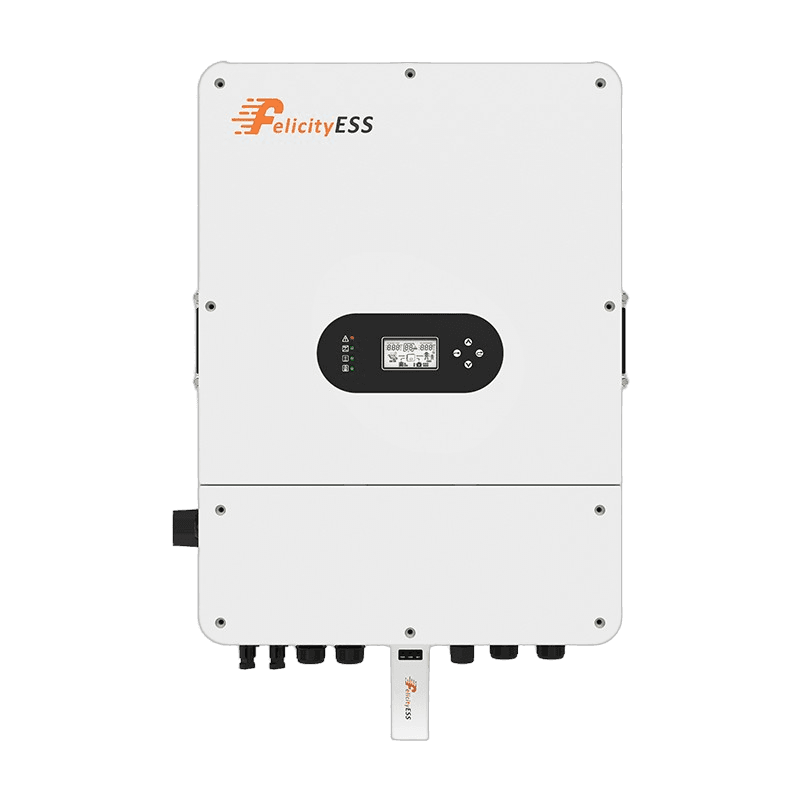
Peak: everything running draws 5,650 W and one air conditioner starting adds 2,400 W, so 8,050 W. The calculator therefore states a 9 kW inverter.
Battery: 25.4 × 8 ÷ 24 = 8.47 kWh. It proposes one FLA48350TG2, 17.5 kWh, counted as 15.75 kWh, because it picks the largest single battery that is no more than twice the need.
Panels: 25.4 ÷ (5.7 × 0.8) = 5.57 kWp, and 5,570 ÷ 580 = 9.6, so ten 580 W panels on about 26 m².
The same result is published on the house overnight-backup system page, one of the ready-made systems computed by this same calculator.
Example 2: starting from the bill
A monthly bill reads 650 kWh. The calculator divides by 30 days: 21.67 kWh a day.
- Battery for eight hours: 21.67 × 8 ÷ 24 = 7.22 kWh.
- Panels: 21.67 ÷ 4.56 = 4.75 kWp, and 4,750 ÷ 580 = 8.2, so nine panels on about 23 m².
- Peak: a bill does not state it, so the calculator estimates it from homes of known consumption close to yours. With a pump or a large air conditioner, the appliance route gives a truer inverter rating.
What to read in the result
The result is three lines — inverter, battery, panels — and each names a product from the catalogue and links to its page, with the price and the datasheet, such as the FLA48350TG2 datasheet. Where the catalogue holds no inverter that fits your load and your kind of system, the calculator writes the rating needed as a plain line with no model, rather than putting a far larger unit in its place.
Before relying on the number, keep two things in mind that the page itself says: the result is a sizing estimate, not an electrical design, and the final installation is signed off by a licensed installer in your country. The sums rest on 5.7 sun hours; on a less sunny site, add panels in the same proportion.
From the sum to the purchase
The price on each product page is the price you pay, and orders are collected from our store in Dubai or Riyadh. To check a line of your result before ordering, ask on WhatsApp and paste the link of the result, which keeps what you entered. Browse Felicity batteries if you want to set another capacity against the one proposed.
Frequently Asked Questions
Do I need to install a solar calculator app on Android or iPhone?
What is the formula for the number of solar panels?
How do I work out battery capacity for the hours of a power cut?
Can the calculator size a system from an electricity bill?
Ready to order?
Every unit in the catalogue carries its price — add it to the cart and order online, then collect it from our store in Dubai or Riyadh.